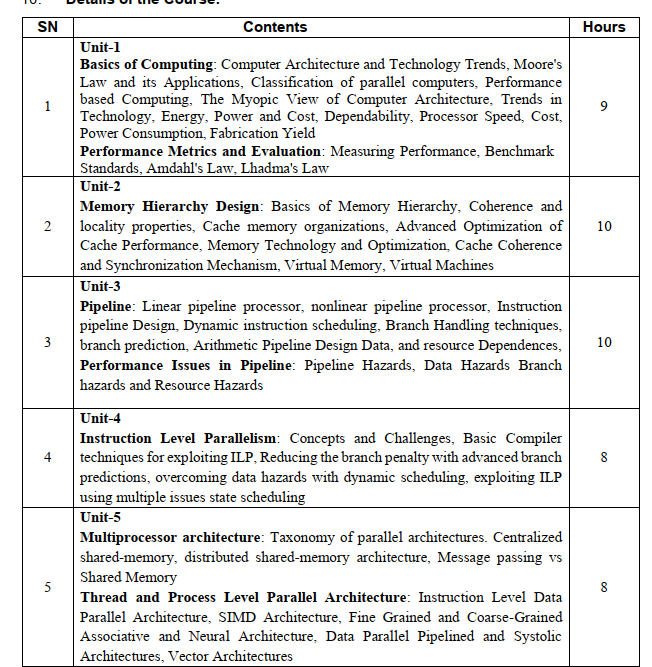
| SN | Contents | Hours |
| 1 | Unit-1Basics of Computing: Computer Architecture and Technology Trends, Moore's Law and its Applications, Classification of parallel computers, Performance based Computing, The Myopic View of Computer Architecture, Trends in Technology, Energy, Power and Cost, Dependability, Processor Speed, Cost, Power Consumption, Fabrication YieldPerformance Metrics and Evaluation: Measuring Performance, Benchmark Standards, Amdahl's Law, Lhadma's Law | 9 |
| 2 | Unit-2Memory Hierarchy Design: Basics of Memory Hierarchy, Coherence and locality properties, Cache memory organizations, Advanced Optimization of Cache Performance, Memory Technology and Optimization, Cache Coherence and Synchronization Mechanism, Virtual Memory, Virtual Machines | 10 |
| 3 | Unit-3Pipeline: Linear pipeline processor, nonlinear pipeline processor, Instruction pipeline Design, Dynamic instruction scheduling, Branch Handling techniques, branch prediction, Arithmetic Pipeline Design Data, and resource Dependences, Performance Issues in Pipeline: Pipeline Hazards, Data Hazards Branch hazards and Resource Hazards | 10 |
| 4 | Unit-4Instruction Level Parallelism: Concepts and Challenges, Basic Compiler techniques for exploiting ILP, Reducing the branch penalty with advanced branch predictions, overcoming data hazards with dynamic scheduling, exploiting ILP using multiple issues state scheduling | 8 |
| 5 | Unit-5Multiprocessor architecture: Taxonomy of parallel architectures. Centralized shared-memory, distributed shared-memory architecture, Message passing vs Shared MemoryThread and Process Level Parallel Architecture: Instruction Level Data Parallel Architecture, SIMD Architecture, Fine Grained and Coarse-Grained Associative and Neural Architecture, Data Parallel Pipelined and Systolic Architectures, Vector Architectures | 8 |
| Total | 45 |
| S N | Name of Authors/Books/Publishers | Edition | Year of Publication Reprint |
| Textbooks |
- Teacher: PRAMOD MEHRA
- Teacher: Dibyahash Bordoloi
After completion of the course the students will be able to: CO1: Understand research problem formulation
CO2: Analyze research related information CO3: Follow research ethics
CO4: Understand that today’s world is controlled by Computer, Information Technology, but tomorrow world will be ruled by ideas, concept, and creativity.
CO5: Understanding that when IPR would take such important place in growth of individuals & nation, it is needless to emphasis the need of information about Intellectual Property Right to be promoted among students in general & engineering in particular.
CO6: Understand that IPR protection provides an incentive to inventors for further research work and investment in R & D, which leads to creation of new and better products, and in turn brings about, economic growth and social benefits.
- Teacher: JYOTIR MOY CHATTERJEE